
Mohandas and the Unicorn
Mini Teaser: Gandhi cuts a saintly figure in the modern imagination. Joseph Lelyveld’s controversial biographical account presents a more dispassionate perspective of the Father of the Indian Nation. An exaggerated creation myth is revealed.
Joseph Lelyveld, Great Soul: Mahatma Gandhi and His Struggle with India (New York: Alfred A. Knopf, 2011), 448 pp., $28.95.
[amazon 9780307269584 full]IF CELEBRITY is a mask that eats into the face, posthumous fame is more like an accretion of silt and barnacles that can leave the face unrecognizable, or recognizable only as something it is not. We might feel we know Mohandas Gandhi, Abraham Lincoln, Albert Einstein, Joan of Arc or Martin Luther King Jr., but, rather, we know their iconic value: their portraits or statues, their famous deeds and sayings. We have trouble seeing them as their contemporaries did—as people. Jawaharlal Nehru, writing in the 1930s when he was in a British prison and some distance from becoming India’s prime minister, said that Gandhi’s views on marital relationships were “abnormal and unnatural” and “can only lead to frustration, inhibition, neurosis, and all manner of physical and nervous ills. . . . I do not know why he is so obsessed by this problem of sex.” Nehru was writing publicly, in his autobiography, but it is fair to say that few Indian politicians today would speak of the Father of the Nation in this unfettered way. Gandhi has become, in India and across the world, a simplified character: a celibate, cheerful saint who wore a white loincloth and round spectacles, ate small meals and succeeded in bringing down an empire through nonviolent civil disobedience. Barack Obama, who kept a portrait of Gandhi hanging on the wall of his Senate office, is fond of citing him.
Joseph Lelyveld has already found himself in some trouble over Great Soul, not for what he wrote, but for what other people say he wrote. In a contemporary morality tale of high-speed information transfer and deliberate misconstruction, his book has been identified as something it is not. The Daily Mail, one of London’s lively and vituperative tabloids, ran a story saying Great Soul claimed Gandhi “was bisexual and left his wife to live with a German-Jewish bodybuilder.” The paper took its lead from a review written by the historian Andrew Roberts, who had suggested Gandhi was, among other things, “a sexual weirdo, a political incompetent and a fanatical faddist.” When the Mail’s story was recast in India, Narendra Modi, the combative chief minister of Gandhi’s home state of Gujarat, banned Great Soul saying it was “perverse in nature. It has hurt the sentiments of those with capacity for sane and logical thinking. Mahatma Gandhi is an idol not only in India but in the entire world.”
Modi, who is unable to obtain a visa to enter the United States because of his complicity in anti-Muslim pogroms in 2002, was seeking to redeem his own damaged reputation by appropriating Gandhi—a project he has been engaged in for some time—so as to soften his image. Modi knew this move would appeal to his constituents, who admire his muscular nationalism as well as his efficiency as chief minister. As usual, a politician was laying claim to Gandhi’s retrospective endorsement. The ban was almost enforced nationally by India’s law minister, Veerappa Moily, until some Gandhi scholars and descendants dissuaded him. Great Soul rose up the best-seller lists. As Andrew Roberts told me, “Banning books is a fail-safe way of giving them huge free publicity. The Gujarat government has just spectacularly shot itself in the foot.” In India, however, a book ban is not really a book ban: it is a way for politicians to gain credence. Anyone who wishes to read Great Soul can still do so, in any part of the country, and it remains freely available in Gujarat’s high-end bookshops. If India’s frequent book bans were genuine curtailments of free speech, it might be assumed that New Delhi’s literary types would make a more serious effort to overturn them.
RATHER THAN a work of sensation, Lelyveld’s book is a measured, judicious attempt to understand Gandhi’s career as a social thinker and activist. It looks forensically at crucial moves and legends that are part of his accepted life story. Instead of focusing on the constitutional machinations that led to Indian independence from British rule in 1947, the author devotes much of his attention to Mohandas Gandhi’s time in South Africa, during which he laid down the principles of direct action and personal sacrifice that could be used to promote social or political change. Lelyveld is well placed to do this: before he became executive editor of the New York Times, he was a correspondent in both India and South Africa, and is also the author of a Pulitzer Prize–winning study of apartheid, Move Your Shadow. He situates the formation of Gandhi’s creative ideas of protest in the rough, churning, ethnically diverse South Africa of the two decades leading up to the First World War.
The starting point is, of course, the episode when the newly arrived Gandhi was ejected from a first-class railway carriage at Pietermaritzburg after a white passenger objected to sharing space with a “coolie” (an Indian indentured laborer). According to a plaque at the railway station, the experience “changed the course of his life” and his “fight against racial oppression” commenced that day. Letter writing was one of his early methods of protest, pursuing righteous causes on behalf of educated Indians in the amalgam of colonies, kingdoms and territories that then made up South Africa. Although he had come to fight a legal case for an Indian Muslim merchant, most of the friends he made were European, and they were often members of ecumenical religious sects. In a newspaper advertisement that went along with a letter to the editor written in 1894, Gandhi described himself as an “Agent for the Esoteric Christian Union and the London Vegetarian Society.” Much of his time was spent trying to work out new ways for people to live, which involved escaping his family and moving to rural communes. In his thirties he took a vow of lifelong celibacy, without first consulting his wife, Kasturba. Lelyveld gently shows that many of Gandhi’s later tales about these days were exaggerated, such as a story of helping countless Indian indentured laborers with their legal problems. In fact, writes Lelyveld: “Initially, his goal was social equality within the empire for his benefactors and clients, the higher-class Indian merchants.”
Like other Indians of his generation who had traveled to Britain—the “home country”—to study, he had what today seems a surprisingly benevolent view of the empire. He took seriously Queen Victoria’s proclamation of 1858, which had formally extended British sovereignty and legal protection in India. In the monarch’s words:
We disclaim alike the right and the desire to impose our convictions on any of our subjects. We declare it to be our royal will and pleasure that none be in any wise favored, none molested or disquieted by reason of their religious faith or observances, but that all shall alike enjoy the equal and impartial protection of the law.
(The influence of this statement can be seen in postwar Britain’s policy of separatist multiculturalism, where each immigrant community was encouraged to pursue its traditional customs rather than to integrate.) It would take Gandhi several decades and much heartache to realize that, for most nonwhite colonials, British promises of partnership and equality of opportunity were meaningless in practice.
By 1910, when the new Union of South Africa came into being as an imperial dominion, people like Gandhi were left with no defined status. As Lelyveld writes, South Africa was now “firmly under indigenous white control, with the result that a lawyerly spokesman for a nonwhite immigrant community, which was what Gandhi had become, could no longer expect to get anywhere by addressing petitions or leading missions to Whitehall.” Gandhi may have been a loyal subject who had worked as an overseer for Indian stretcher-bearers in the Boer War, carrying wounded British soldiers away from the front, but now he was discriminated against by racial laws. He reacted by engaging in a campaign of nonviolent resistance (this was to be critical in the development of the techniques he would later use in India). Deploying flying columns of women and thousands of indentured laborers who chanted Hindu slogans as they marched, he brought the mines and plantations of eastern South Africa to a standstill. Lelyveld has a lovely description of Gandhi “serving as quartermaster, cutting the [bread] loaves into three-inch hunks, then . . . digging with his thumb a small hole into each hunk, which he then filled with coarse sugar as the men filed by in successive batches of a dozen strikers each.” Mobilization and direct action were accompanied by tactical letters to people in power, and by extensive, manipulative self-promotion.
Despite violent repression, many of the strikers’ demands were conceded, with the British viceroy across the sea in India praising their “resistance to invidious and unjust laws” in South Africa. The revolt was, according to Gandhi, “a religious struggle”—and as it unfolded, he happily lectured the strikers against evils like smoking and drinking. Lelyveld remarks that by “assuming for himself sole authority” over the campaign, “Gandhi was short-circuiting normal politics, including protest politics.” It was this understanding of the power of unarmed mass movements to challenge injustice that was to be his greatest legacy. He had a genius for “reading” social protests, for taking their temperature and deciding when to step back the efforts and when to march them forward—often for reasons that were unfathomable to those around him, relying simply on his own intuition.
Pullquote: Gandhi was not, contrary to later reworkings of his story, a liberal: he liked to lay down rules, was often undemocratic and his ideas were in certain respects traditionally Hindu.Image: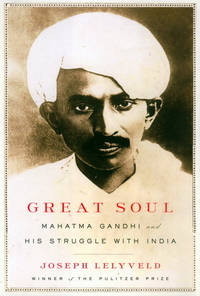 Essay Types: Book Review