
Not a Win for Progressivism
Great presidents form new alliances that reshape the political landscape. Obama hasn't.
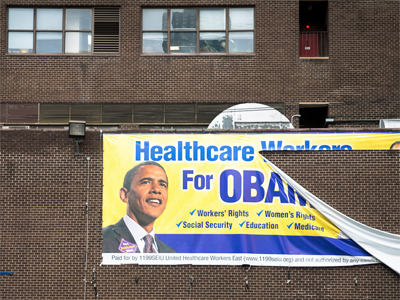 A campaign sign damaged by Hurricane Sandy. Flickr: Thing Three.Throughout the presidential campaign that ended this week with Barack Obama’s victory, it was often suggested that the election was a high-stakes, crossroads contest to determine whether the country wished to continue along the lines of the incumbent’s governing philosophy, including a significant role for government, or opt instead for the more small-governmental outlook of GOP challenger Mitt Romney. Thus, it was assumed that the election would settle, at long last, the political deadlock that has gripped the country for, lo, too many years.
Alas, that is not how presidential elections work, and that is not what this electoral contest signifies. Presidential elections don’t break deadlocks; presidential leadership does. Elections merely determine which leader will have the chance to do so.
To understand this, it’s necessary to understand what actually drives presidential elections. They’re referendums on the performance of the incumbent, or the incumbent party when the incumbent president is retiring. The operative phrase is “eligible for rehire.” The American people have hiring and firing authority over their presidents, and they take the responsibility very seriously. When the incumbent’s performance is adequate or better, the incumbent or incumbent party wins; when it falls below adequate, the incumbent or incumbent party is tossed out.
Viewing presidential elections through this prism, one sees how remarkably nonideological the electorate is—and how much political pragmatism it brings to the equation. Consider, for example, the 1980 election, when voters rejected incumbent Jimmy Carter, a Democratic liberal, and turned instead to Ronald Reagan, certainly one of the most conservative presidents of the twentieth century.
The voters didn’t toss Carter aside because they didn’t like his political philosophy; they did so because his leadership had failed. And they didn’t turn to Reagan out of a suddenly acquired passion for traditional American conservatism; they turned to him because of Carter’s failure. Similarly, voters retained Reagan four years later because they viewed his incumbency as successful. And, based on normal indices of voter assessment, it was a success, whether the index is inflation, unemployment, interest rates, economic growth, domestic-policy innovation, domestic tranquility or avoidance of serious foreign-policy setbacks.
Obama won this week because, based on his four-year record, he met the threshold of eligibility for rehire—but barely. In truth, his performance generally was lackluster. Economic growth—subpar. Employment numbers—subpar. Breaking the political deadlock besetting the nation—a failure. Innovation in domestic affairs—a triumph with his Affordable Care Act but a pricey victory given the widespread unpopularity of that legislation. But the electorate found his foreign-policy record more to its liking. Voters approved his bold decision making that led to the death of Osama bin Laden and also his smooth success in getting America out of the unpopular Iraq war. He also crafted a plan for a U.S. withdrawal from Afghanistan and seemed to be executing it successfully. He presided over no serious foreign-policy setbacks, although the attacks against the U.S. personnel in Benghazi, Libya, which killed an American ambassador and three other U.S. citizens, certainly were a net negative for the president. No major scandals. No serious civic unrest.
All in all, just good enough for reelection. Whether Obama has positioned himself for second-term success is an entirely different question. As I wrote last month, truly successful presidents met their respective crises or worked through the defining issues of their day by transforming the country’s political landscape and creating new political fault lines that spawned new governing coalitions. In doing that, they managed to bring a new level of stability to the politics of the nation, allowing it to move forward into a new era.
Consider Lyndon Johnson’s success in breaking the nation’s logjam on civil rights and in furthering unfinished New Deal initiatives; or Richard Nixon’s incorporation of the George Wallace constituency into the Republican Party; or Reagan’s ability to lure “Reagan Democrats” to his party banner. All of these successes led to landslide victories at the next election.
Obama, on the other hand, sought to govern on the basis of old fault lines and an old Democratic coalition that no longer can generate a clear national consensus on how the country should deal with the crises at hand. He brought no new ideas to his party and hence no new voters to it. He not only failed to break the country’s political deadlock but also deepened it, rendering it all the more intractable and poisonous. That’s why his reelection margin was so narrow.
None of this bodes well for the president’s second term. It’s a reality of the American political system that national crises are solved through presidential leadership or not at all. And the country is in crisis—or, more accurately, beset by a number of intertwined crises. There is the persistent dynamic of Islamic fundamentalism in the Levant, focused on America as an enemy to be brought low through terrorist murder and societal disruption. There is the lingering economic stagnation that thwarts business investment and employment opportunity as income disparities widen. There is the growing evidence that America’s position in the world is facing progressive erosion, which in turn breeds looming geopolitical challenges. Most ominously, there is the country’s precarious financial position stemming from governmental-spending commitments (state, local and federal) that threaten to engulf the national economy. Finally, there is the widespread loss of national confidence engendered by these other persistent or looming emergencies.
Obama brought forth in his first term no comprehensive program to address these intertwined crises. And he certainly brought about no political realignment of the kind associated with the truly successful presidents of our heritage. Hence, both his opposition and his own troops in Congress have become more hardened in their commitment to the politics of old, precisely the kind of politics that have proved incapable of generating a serious solution to the country’s woes.
Is it too late for Obama to break the deadlock by crafting a new coalition based on new thinking and powerful new alliances? Of course not. But it will be more difficult in the second term than it would have been in the first. And there’s little evidence that the president sees this as a crucial political imperative in any event.
And so it’s likely that the next four years will be rather like the last four, with the country’s persistent problems becoming increasingly intractable. That’s not a recipe for moving the country out of its current morass of economic sluggishness, fiscal threat and voter frustration. Neither is it a recipe for Democratic success when the next presidential referendum rolls around.
Robert W. Merry is editor of The National Interest and the author of books on American history and foreign policy. His most recent book is Where They Stand: The American Presidents in the Eyes of Voters and Historians.
Image: Thing Three.