
Russia's Endgame in Syria
As Moscow sends a naval sqaudron to its Syrian facility, the Kremlin weighs the pros and cons of Assad's fall.
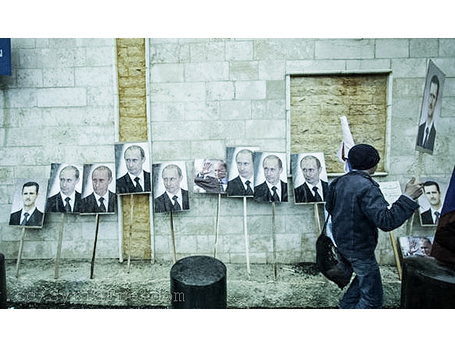 The Interfax news agency reported Tuesday that a Russian naval squadron, including an antisubmarine ship and three marine-landing craft, left Severomorsk in the Arctic for the Mediterranean. Several more ships will join it en route. Together, they will pay a call to Tartus, Syria, Russia’s only naval facility outside of the old Soviet Union.
Russian officials have denied the port visit has anything to do with the ongoing internal conflict in Syria. But Moscow has become increasingly pessimistic that the Assad regime can survive. In June, Russian military officials were reported to be entertaining the possibility that it will be necessary to send the “naval infantry,” as marines are known in Russian, to Syria to protect infrastructure and evacuate approximately thirty thousand Russian citizens.
Since the mid-June collapse of the Annan plan and the departure of UN observers from Syria, the question has not been whether Assad will survive but rather how much blood will spill before violence culminates and what will follow next.
As much as Moscow would hate see the Assad regime go, Russians are realizing that state resistance will make things worse. Power transition is the only way to avoid even more tragic post-civil war outcomes. That’s why this week Moscow is hosting representatives from the Syrian National Council (SNC), one of the two main opposition groups, who have come to discuss transition mechanisms and convince Russian leaders to drop Assad.
On July 9, Russia’s deputy head of the Federal Service for Military-Technical Cooperation unexpectedly announced that Russia would not sell any new weapons to Damascus as long as the situation in the country remains unstable. As Syria’s major international ally and arms supplier, Moscow seems to be trying hard to persuade Assad to seek settlement with the opposition.
Prior to that, on the eve of President Putin's visit to Israel, Russia announced it would not sell long-range antiaircraft S-300 missiles to Damascus. The sale probably would not take place while Assad is in power, and Moscow's growing ties with Israel—including technological cooperation and tourism—may be more important than the destabilizing arms sales for which Damascus may have no hard cash.
There are now three scenarios in Syria: an all out civil war, a unilateral intervention by NATO and a Yemen-style political transition. The last scenario would be optimal for the West, Turkey and the opposition’s Gulf supporters—but not for Russia, of course. It would require the Assad government to transfer its authority to a transitional body of technocrats and hold free elections in a year. Such a transition wouldn’t be easy and could fail at any step of the process, not least because the opposition rejected a similar plan proposed by world’s powers in Geneva on June 30.
Some might view the impending regime change in Syria as a victory over Iran, which is allied with heterodox Shia Alawites, the current ruling minority in Syria. Others might see it as a victory for the Gulf-supported Sunnis, something that may further complicate the already destabilized region. The Alawites’ fall may throw Syria into chaos, precipitating the decay of the post-Ottoman state’s complex political and ethnic alliances. It also may facilitate a Sunni Islamist groundswell that may not lead to democracy and modernization.
A civil war in Syria would have a significant impact on states in the region—especially Iraq, Iran, Lebanon, Jordan, Israel and Turkey. Israel could face a heightened risk of conflict resuming along the cease-fire line on the Golan Heights, where the Assads have enforced quiet since 1974.
For Russia, the fall of Assad would mean the loss of its only naval port outside the former USSR and the loss of a considerable weapons market. Following regime changes in Egypt and Libya, Syria and Iran are Russia’s last remaining clients in the Middle East. Moscow would hate to see them go.
Ariel Cohen, Ph.D., is senior research fellow in Russian and Eurasian Studies and International Energy Policy at The Heritage Foundation. Dmitry Titoff assisted with preparation of this article.
Image: Freedom House