
The Effort to Delegitimize the Tea Party Movement
A response to Vanity Fair's shameful attempt to drum the Tea Party out of the national discourse.
 The Tea Party movement drives the American Left crazy. Liberals have demonstrated an almost desperate desire to write it out of the American mainstream so it can be derided and dismissed without having to be engaged in normal discourse. Early on there was a persistent effort to pin the label of racism on the movement. That fizzled for lack of evidence, and now it turns out, according to polls, that Republican presidential aspirant Herman Cain derives a significant portion of his support from Tea Party adherents. So much for that tactic.
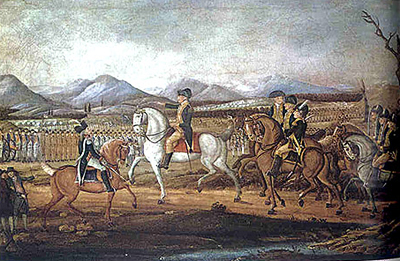
Now the latest edition of Vanity Fair magazine attempts a more sophisticated approach—in keeping with the New York sophisticates who produce that journal. The magazine carries a piece by two economics bloggers—Simon Johnson and James Kwak—arguing that today’s Tea Party movement has nothing in common with the Boston Tea Party or the American Founders or the underlying principles of the grand American experiment. No, it’s etymology is more accurately traced to the Whiskey Rebellion, that antitax revolt from the early years of the Republic that had to be put down by threat of force by George Washington himself, who personally traveled to Pennsylvania as president to lead the anti-rebellion forces.
The dichotomy drawn by these two bloggers is both stark and clever. On one side we have the Founders, most notably Alexander Hamilton. On the other side were the whiskey rebels. Hamilton, write the authors, learned a powerful lesson during the travails of the Revolutionary War: “Hamilton’s conclusion was simple: You cannot run a prosperous and secure independent country without the ability to finance the sudden surge in spending called for by a national emergency—which requires borrowing large amounts of money quickly.’’ And that ability to borrow requires a significant tax base.
They note, accurately, that as the country’s first Treasury secretary Hamilton created the system of public finance that became the economic foundation for America. That system of course encompassed the power to tax, including a tax on whiskey. That riled farmers in western Pennsylvania who produced whiskey. They grabbed their pitchforks and muskets and gathered into an angry mob. That stirred Washington’s decision to lead an effort to suppress this rebellion; the Whiskey Rebellion faded away; and—say Johnson and Kwak—the republic was saved from the likes of today’s Tea Party followers.
So there were Hamilton, Washington and the builders of America—political ancestors of Barack Obama; and then there were those rabble-rousing Pennsylvania farmers bent on destroying the Republic’s power to tax and hence the Republic itself—progenitors of today’s Tea Party.
This is lousy history, pulled together with an all-too-transparent political agenda. So what are the facts? Alexander Hamilton was a great American, but he was a big-government man whose desire to invest power in the federal establishment set off forces of opposition. Indeed, at the 1787 Constitutional Convention in Philadelphia, he delivered a six-hour speech in which he strongly urged presidential life tenure. He said he wanted a system as close to British monarchy as the people of the New World would accept. He was politely ignored by his fellow delegates.
The leader of the Hamilton opposition was Thomas Jefferson, who objected to Hamilton’s advocacy of federal power concentration because he believed such concentrations would always lead to abuse. In his first message to Congress, Jefferson vowed to abolish all internal federal taxes and reduce federal expenditures and personnel. He attacked a system in which “after leaving to labor the smallest portion of its earnings on which it can subsist, government…consume[s] the residue of what it was instituted to guard.’’ Hamilton naturally was aghast. He said this attack on Federalism should “alarm all who are anxious for the safety of our government.’’
Thus was born a great political fault line in American politics—the fault line between the politics of Hamilton (later embraced with creative brilliance by Henry Clay) and the politics of Jefferson (later infused with even greater political force by Andrew Jackson). Jefferson’s party dominated American politics for twenty-four years following his 1800 presidential victory, but eventually it split into two factions that would become Jackson’s Democratic Party and Clay’s Whig Party.
Clay wanted the power of federal Washington brought to bear boldly on behalf of domestic prosperity. He crafted a philosophy of governmental activism and devised a collection of federal programs and policies he considered essential to American prosperity—big federal public-works projects; high tariffs; the magisterial Bank of the United States; and federal land sales at high prices to generate federal dollars and hence federal power.
Jackson opposed all this. He believed that concentrated governmental power always led to corruption and abuse. So he advocated a diffusion of power, keeping it as close to the people as possible. He didn’t buy Clay’s vision of building up America from above—through elites fostered by government—because he felt assured that ordinary folk, left to their own devices, would build it up from below. Don’t sell land at high prices to invest the federal government with money and power, he said; sell it cheap or give it away and then watch Americans build towns, churches and commerce through their own ingenuity and hard work.
In vetoing legislation to foster federal road projects, Jackson said the people had a right to expect a “prudent system of expenditure’’ that would allow the government to “pay the debts of the union and authorize the reduction of every tax to as low a point as…our national safety and independence will allow.’’ Once the national debt from the War of 1812 was repaid, he promised, the government would make surplus resources available to the states for internal improvements. But he could not sanction direct expenditures for projects that went beyond purposes of defense and national benefit. The problem, warned Jackson, was that such power in the hands of federal officials would lead inevitably to “a corrupting influence upon the elections’’ by giving people a sense that their votes could purchase beneficial governmental actions to “make navigable their neighboring creek or river, bring commerce to their doors, and increase the value of their property.’’
Consider the relevance of these expressions to our own time. Jackson talks about a “prudent system of expenditure’’—government operating within its means. He wants to “pay the debts of the union’’—extricating the country from the dangers inherent in ongoing deficit finance. He advocates “the reduction of every tax to as low a point as…our national safety and independence will allow’’—invoking modern supply-side thinking. And his warning about buying votes with special favors calls to mind today’s controversies over appropriations “earmarking.’’
Jackson’s political philosophy, not Hamilton’s, dominated American politics generally for nearly a century—until Franklin Roosevelt bundled up the Hamilton-Clay philosophy into a thoroughly modern political juggernaut and created a new day in American civic life. But his need to eclipse the lingering vestiges of Jacksonism is reflected in the fact that the U.S. Supreme Court, still a bastion of Jacksonian thinking, struck down nine of eleven major FDR initiatives in the early years of his presidency. Those initiatives, said the Court, were unconstitutional. It wasn’t until the Court’s makeup changed with a number of justice deaths that the Jacksonian dominance of the Court finally ended.
So it is Jackson, not the whiskey rebels, who is the progenitor of today’s Tea Party movement. And the debate it has engendered is traceable to the great, ongoing debate between the forces of Hamilton-Clay and the forces of Jefferson-Jackson. This is an honorable debate in the country’s history, with strong arguments and honest convictions on both sides. There may be times when one side or the other should prevail because of the particular problems faced by the country. And thus it would be dangerous to American democracy if either side of the debate were drummed out of the national discourse as politically illegitimate, as merely a vestige of people of old bent on destroying the fledgling republic.
That’s what Johnson and Kwak—and Vanity Fair—sought to do. And it carries with it far more shame than anything that has emanated from today’s Tea Party movement.