
Meshal Goes Out of Bounds
The Hamas head's hardline remarks were foolish enough to harm even his own interests.
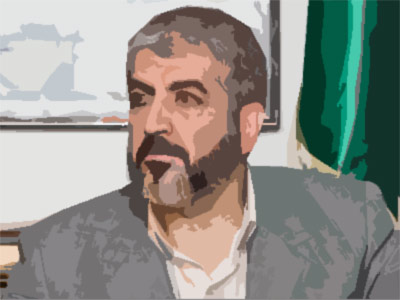 What Hamas political leader Khaled Meshal said at a mass rally in Gaza City on Saturday was contemptible. Taken at face value, his words eradicated any distinction between Israeli and Palestinian territory, and any possibility of Israelis and Palestinians living in peace. “Palestine, from the river to the sea, from north to south, is our land,” he said. “Not an inch of it can be conceded,” Meshal continued, adding that “Israel has no right in Jerusalem.” The words were despicable because they deny the right of Israelis to live in their own state, in their own part of the former mandate of Palestine.
What Meshal said was not only despicable but dumb. His words contradicted the repeated indications from Hamas that it is willing to observe a hudna, or indefinite truce, with Israel if a Palestinian state is created based on the 1967 boundaries and is approved by a majority of Palestinians in a referendum. Meshal also implicitly contradicted himself by referring favorably in the same speech to Palestinian unity and reconciliation with Fatah, a theme to which he returned in a speech at the Islamic University of Gaza the following day. Given the now firmly established commitment to a two-state solution by Palestinian Authority President Mahmoud Abbas—who only recently received headlines for commenting publicly about how a former refugee like himself will never return to live in what is now the state of Israel—reconciliation can come about only within a two-state framework. And a two-state framework is the only one that can ever enable Palestinian national aspirations to be realized.
Meshal's words were an open invitation to Israeli Prime Minister Benjamin Netanyahu to respond with an equally hard line statement that with comments like that from a Palestinian leader then there is no hope for any negotiated peace and no reason for Israel to concede an inch of land either. Which is exactly what Netanyahu did in remarks on Sunday.
Someone with Meshal's background and position ought to be smart enough to realize all this, and to realize further that there is no such thing as speaking publicly to one audience without having effects on other audiences. In this case the other audiences are not only Israelis but governments and publics elsewhere. What Meshal was doing on Saturday is what American politicians might call stirring up the base. But he cannot just shake his Etch-a-Sketch and take a more sober posture later without already sustaining diplomatic damage.
Probably he got swept up in the mood of the moment—all those people, all those green flags, and the euphoria stemming from the belief (which Hamas has done its best to promote) that Hamas was a winner in the recent armed clash with Israel. If Meshal was partly trying to sustain that euphoria, he overplayed his hand; politicians have been known to do that in euphoric moments. He probably undid some of the sympathy that Gazans received as they sustained the latest pounding from Israel.
Then there are the circumstances more personal to Meshal. This past week was the first time he had ever set foot in—and kissed the ground of—the Gaza Strip. He also is someone whom the Israelis have tried to assassinate. It probably doesn't take much in the way of momentary moods to cause someone in such a situation to go over the top in talking about his would-be assassins.
There is plenty of reason to believe that Hamas leaders, including Meshal, still favor the indefinite hudna based on 1967 borders. There are far too many indications of that to be outweighed by emotional comments at a rally. That formula also offers the politically ambitious Hamas leadership the only chance that they will ever govern anything other than the miserable little corner of Palestinian territory that is the Gaza Strip (and given Israel's continued strangulating control over the Strip, it is a stretch to say that Hamas “governs” even that).
Everybody—including Israel, Abbas, and the United States—ought to eschew general labels and categorizations when responding to Hamas. It accomplishes nothing simply to call the group a bunch of terrorists or a bunch of heroes and to assume that everything flows from that. The proper response is to react to specifics, whether negative or positive. When a Hamas leader says what Meshal said on Saturday, the remarks should be condemned (and Abbas was delinquent in not doing so). When they say instead what they have said more often about accepting a peace based on 1967 borders, they should be told that they are on the right track. They should be led to understand that the former approach will mean nobody will have reason to have anything to do with them, but with the latter approach they will be accepted as an important interlocutor.
Image: Wikimedia Commons/trango.
