
Syndicate content

The Skeptics

The Truth Is Out There

Adam Berinsky from M.I.T. reports over at YouGov that less than a year after President Obama released his long form birth certificate, the number of Americans who believe that Obama is an American citizen has dropped back to same level as before the certificate was made public. The percentage of Republicans who believe Obama is an American has dropped even lower than before. Rumors, Berinsky argues, die hard, and thanks to the Internet, they spread faster and further than ever before.

Rumors may seem a bit far afield for this blog. But in fact, rumors are close cousins of lies, misinformation and propaganda, standard tools of foreign policy in democratic nations and dictatorships alike. Rumors, like their cousins, are designed to alter judgments about people and policies by shifting the basis on which citizens consider them. For example, recent rumors about Obama’s “death panels” can be understood as an effort to shape judgments about Obama’s health care plan by focusing attention on a specific element of that plan (end of life decisions) through the strategic use of misinformation (i.e., that there would be such things as panels determining who would live and die). In this sense, the death-panel rumor differs very little from the Bush administration’s claims about Iraqi WMD in the run up to the 2003 war.

Sadly, Berinsky’s findings are not surprising. As John Stuart Mill argued 150 years ago in On Liberty:

It is a piece of idle sentimentality that truth, merely as truth, has any inherent power denied to error, of prevailing against the dungeon and the stake. Men are not more zealous for truth than they often are for error…

Indeed, one of the most depressing things about Berinsky’s findings and those of others who have studied misinformation is how closely connected misinformation is to people’s desire to believe the worst about their partisan opponents, other social groups, etc. Partisans these days, it seems, are zealous to learn and quick to believe the worst about their opponents.

Worse yet, there seems to be little that can be done to correct misinformation once it takes root. In their recent piece in Political Behavior, for example, Brendan Nyhan and Jason Reifler conduct experiments aimed at discovering whether or not news stories were capable of correcting misinformation about Iraqi WMD by including corrective statements in articles also containing misleading information. Not only do they find that the corrections were generally ineffective, they find several instances of a backfire effect, in which the correction effort actually increased the rate at which the most partisan subgroups believed the misinformation.

Beyond the partisan bias issue, Nyhan and Reifler’s findings also point out that the news media’s approach to covering rumor and misinformation is not helping. Handcuffed by the commitment to “objectivity,” the mainstream news media will continue to repeat bogus claims even as journalists seek to debunk them, with the unintended effect of actually strengthening rumors and increasing misinformation (Studies have shown that “adwatch” news stories have a similar effect for political advertising claims). Those who can still recall Al Gore’s documentary An Inconvenient Truth will note that these findings jibe closely with Gore’s argument about news coverage of climate change. Despite near universal agreement among scientists about the human origins of climate change, Gore complained, news media accounts have continued to provide equal time to climate change skeptics in order to provide “objective” coverage, thus encouraging climate change doubters to hold fast onto their beliefs.

John Stuart Mill believed that men were "corrigible," that with sufficient discussion, opinions would improve over time and the truth would lead toward consensus. He also believed that the truth has one special advantage over falsehood: it is true! As a result, though it may not be recognized at any given time, it will always be there to be rediscovered. Given recent research, however, it appears that Mill’s confidence was misplaced, and that there in fact is no assurance that politically motivated people are interested in the truth. And sadly, it may be that American politics of the past generation reveals the implications of a world in which the truth has no special hold over the American public.

Occupy Afghanistan

In an essay for Armed Forces Journal, Army Lt. Col. Daniel L. Davis writes that after traveling across Afghanistan and speaking with more than 250 soldiers in the field, “What I saw bore no resemblance to rosy official statements by U.S. military leaders about conditions on the ground.” Further down he continues, “I witnessed the absence of success on virtually every level.”

It’s hard to disagree.

Davis’s essay comes weeks after the top-secret 2011 National Intelligence Estimate on Afghanistan finds that security gains in the Afghan war are unsustainable and that pervasive corruption, government incompetence and militant safe havens in Pakistan have undercut progress.

I’m reminded of a comment made recently by Senator Dianne Feinstein (D-CA), who chairs the Senate Intelligence Committee:

There have been gains in security . . . but the Taliban is still a force to be reckoned with. They still occupy considerable land in the country.

“Occupy” is the operative word in that sentence. That gains in Afghanistan are “fragile and reversible” is the oft-repeated mantra of defiant optimists who invoke our inability to achieve key objectives—improve local governance, eradicate corruption, convince Pakistan to shut down safe havens, etc.—as reason to remain in Afghanistan indefinitely. Mind you, the opposite is also true: if such objectives are somehow reached, then we can never leave, since leaving would risk jeopardizing the gains we’ve won.

The intractable cross-border insurgency, of course, will outlive the presence of international troops. After all, a local district mullah who moonlights as a Taliban operative has nowhere else to go. Indeed, as the last ten years have shown, insurgents can outlast coalition troops by merely reemerging after we’ve left—that’s an endurable occupation.

In separate dissents appended to the report mentioned above—a report that reaches similar conclusions about the war made in the 2010 N.I.E.—the U.S. commander in Afghanistan, Marine Gen. John Allen, and the U.S. ambassador to Afghanistan, Ryan Crocker, agreed in the judgment that the Taliban have shown no readiness to abandon their political goals. And, according to Col. Brian Mennes, who commands 3,300 troopers of the 4th Brigade: “The Taliban are going to have a role in post-war Afghanistan. . . . They are Afghans. They are there—it’s just physics!’”

Coalition night raids and drone strikes have managed to eliminate the Taliban’s numerous shadow governors, mid-level commanders and weapons facilitators; however, as the 2011 N.I.E. was quoted as saying, the Taliban’s “strength, motivation, funding and tactical proficiency remains intact.” And “many Afghans are already bracing themselves for an eventual return of the Taliban.”

From war fighters and trigger pullers to desk-bound spooks and armchair analysts, the conclusion reached is that after a decade of war, we still haven’t won. The reason? All politics is local.

Remember that a key component of the Obama administration’s strategy for Afghanistan was winning over local people and luring them away from the Taliban. But the always-perceptive Captain Cat, who has worked on Afghan peace building, offers insight into what went wrong:

As we talk and sip tea, the younger man’s brother arrives, wrapped in a patu. He keeps his hair long, jihadi style, and it pokes out of his pakool. He was a more senior commander than his younger brother, and only reconciled a few months ago.

I ask the commander what he does with his days. “The government doesn’t trust anyone who is reconciled, so no one will hire us. My other brother does small jobs, he owns a cart in town and he sometimes does delivery work. He gets calls from Miram Shah from the Taliban and they tell him “look at your life now, pushing carts. What kind of a man are you?”

“I really regret reintegrating with the government, I wish I hadn’t—but if I go back now, the Taliban will kill me”.

We shake hands and I leave them. Miserable, bored and ashamed, they will while away their days wondering how to feed their families, when the Taliban will come for them and why they put their trust in the government. It’s hard not to wonder the same thing.

Tragically, the vast majority of Afghans were initially happy with the foreign-troop presence. They took a “wait-and-see” approach. But that spirit has largely deteriorated. Conversely, the Taliban are reviled, but the general view among many Afghans toward the movement is either ambivalence or that the Afghan government is worse. Perhaps more importantly, as the Afghan government’s head of Rural Rehabilitation and Development insisted to me at his office in Kabul awhile back: “Taliban is part of our culture.”

The coalition’s deus ex machina is reconciliation with the Taliban. While such an outcome to the war is hardly a victory worth celebrating, it’s difficult to imagine a lasting solution that does not involve the war’s other occupying force, the Taliban.

Image: isafmedia

Afghanistan

Libya Begets Syria?

A little over a year ago, as members of the Obama administration were pondering military intervention in Libya, skeptics (including The Skeptics) pressed them to explain how that situation differed from other comparable cases elsewhere in the world. If Libya, why not Yemen? Why not Bahrain? Why not Syria? We may soon learn the answer to that last question. And their too-permissive—or merely haphazard—approach a year ago might pave the way for an intervention in Syria that would be ill-advised, if not disastrous.

At the time of the Libya debate (to the extent that there was one), the president and his foreign-policy advisers dismissed concerns that the intervention in Libya would set a precedent. "It is true that America cannot use our military wherever repression occurs," President Obama said in a televised speech to the nation on March 28, 2011. But, he continued:

that cannot be an argument for never acting on behalf of what's right. In this particular country—Libya—at this particular moment, we were faced with the prospect of violence on a horrific scale. . . . To brush aside America's responsibility as a leader and, more profoundly, our responsibilities to our fellow human beings under such circumstances would have been a betrayal of who we are.

At other times, the administration alluded to a loose set of guidelines to explain why it might choose to use force, guidelines which the Libya case met but other cases supposedly did not. These included the likelihood that a large-scale loss of life was imminent; the belief that prompt military action would prevent this violence; and the support of the international community, ideally a formal sanction in the UNSC (absent that, the approval of a regional body, such as the Arab League, might suffice).

Notably absent was sufficient consideration of whether our vital strategic interests were at stake. They were not in Libya, and they are not in Syria.

We should strive to avoid foreign intervention in all but very rare cases. Because getting in is always much easier than getting out, the burden of proof must always be on those making the case for war, not those advising against.

Beyond that, we must know what mission the U.S. military has been tasked with performing. We must have a reasonable estimate of the likelihood that it will achieve its mission. And we must have some sense of the likely costs in blood and treasure. Finally, we are a nation of laws, not of men—and decidedly not of one man. The president has very little authority to send troops into harm’s way, and he has none when U.S. security is not at stake (a criteria that Barack Obama endorsed as a senator but abandoned when he assumed a higher office). If the Obama administration is considering military action to remove Bashar al-Assad from power in Syria, it should obtain formal congressional authorization for such action. And it should do that before going to the United Nations.

No other country is afforded such choices. No other country is able to project power over great distances and on very short notice. No other country has a track record of frequent foreign intervention, even when such operations have no direct connection to advancing our own security. This pattern of behavior constitutes our unique power problem. It is precisely because the United States has used force on numerous occasions over the past two decades that we need a particularly stringent set of criteria governing our future interventions. There is an almost endless parade of aggrieved parties calling on Uncle Sam to save them from harm. And when Washington refuses, or merely drags its heels, they will say: You fought to save Muslims in Bosnia and Kosovo, why do you then refuse to aid Muslims in Northern Africa or the Levant? The United States must have a ready answer.

But the Obama administration, cheered on or goaded by liberal and neoconservative hawks, does not have one. Yet. And its halting signals are likely to embolden those calling for yet another war.

Image: Alain Bachellier

Syria

Washington's UN Temper Tantrum

Dmitri Medvedev with Hu Jintao (www.kremlin.ru)U.S. Ambassador to the United Nations Susan Rice huffed that her country was “disgusted” by Russia and China’s decision to veto a UN Security Council resolution condemning the violence in Syria and calling for an immediate end to that bloodshed. Their actions, she added, were “shameful” and “unforgivable.” Not only could Ambassador Rice apparently use a refresher course in diplomatic language, Washington’s response also betrays a troubling arrogance on two levels.

First, U.S. officials seem to believe that even such major powers as Russia and China should simply kowtow to the United States and adopt whatever measure Washington and its allies want on any subject, even when such a measure might be contrary to the interests of Moscow and Beijing. That is an offensive attitude that is provoking more and more irritation and resentment not just in those capitals but in such places as Ankara, Brasilia and New Delhi as well. Someone needs to convey a message to Rice and other Obama-administration officials—and much of the U.S. foreign policy community—that America’s “unipolar moment” is over and that other powers in the international system are increasingly unwilling to take dictation from Washington.

Second, U.S. leaders apparently assume that their Russian and Chinese counterparts have severe cases of amnesia and, therefore, do not recall how the United States and its NATO allies repeatedly exploited and perverted previous UN Security Council resolutions regarding other situations. Vitaly Churkin, Russia’s ambassador to the UN, clearly had suspicions about the prospect that even a seemingly mild resolution on the violence in Syria could be twisted for more ambitious policy goals. Although he condemned the bloodshed in Syria, Churkin cited Russian concerns about “regime change” intentions by “influential members of the international community.”

Given the track record of the United States and its NATO partners, Churkin was hardly being paranoid. He very likely recalled the 1999 UN Security Council resolution on Kosovo, which Moscow and Beijing reluctantly accepted following NATO’s unauthorized air war against Serbia, and how Washington and the European powers later ignored the provision that explicitly considered Kosovo still to be Serbian territory, albeit under international occupation. In blatant violation of that provision, the United States and key NATO countries bypassed the UN Security Council and recognized Kosovo’s unilateral declaration of independence in February 2008. Moscow and Beijing both complained vehemently that the action of the Western powers was not only illegal, it set a terrible international precedent that could cause problems for numerous countries, including Russia and China.

And Churkin likely recalled the more recent episode in which Moscow and Beijing foolishly accepted a UN Security Council resolution authorizing limited air strikes in Libya, supposedly for the purpose of protecting civilian populations. The ink was barely dry on that resolution before the United States, Britain and France used extensive air strikes to assist rebel forces opposing the regime of Muammar Qaddafi. In other words, an ostensibly humanitarian mission became a cynical fig leaf for a regime-change strategy that NATO was pursuing.

Having been burned on those and other occasions when they went along with UN initiatives favored by the United States and its allies, it is hardly surprising that Moscow and Beijing would be suspicious and hypercautious about even a seemingly innocuous resolution on Syria’s violence. Susan Rice’s temper tantrum in response to their vetoes will certainly not allay suspicions about U.S. motives. Indeed, that reaction will likely intensify Russian and Chinese wariness.

China, Russia, Syria

Unanswered Questions on Afghanistan

Secretary Panetta’s announcement that the U.S. combat mission in Afghanistan will end as early as mid-2013 is a positive development. But it is long overdue and still leaves too many questions unanswered. After more than ten years of war in Afghanistan, the administration should follow through on its commitment to end combat operations and withdraw all troops by 2014. Continuing to narrow our objectives will make this war winnable.

Politically, this makes perfect sense for the Obama administration. It is a shot across the bow of his political opponents and those wishing for an indefinite combat mission in Afghanistan. Secretary Panetta’s announcement allows the administration to get on the side of voters who want to draw down in Afghanistan. By opposing any drawdown, his critics side with the much smaller segment of the American people who still support the nation-building mission.

President Obama is in a position similar to the debate over Iraq in his 2008 presidential campaign. He argued in 2008 that he would end a grinding war he inherited. The president can claim victory (and vindication) in Iraq and argue that if you liked the first act, you’ll love the second. He will end another grinding war he inherited—and conveniently gloss over the fact that he sent more troops to Afghanistan than President Bush ever did.

Of course, these developments are neither new nor a sure thing. Despite the media attention given to this announcement, it was somewhat predictable. Panetta acknowledged that this was always part of the plan behind the scenes. Buried in the coverage of Panetta’s statement are multiple qualifiers. He admitted that no decision has been made on the number of troops that will leave in 2013. The secretary offered no details on what this transition from combat operations would look like. Indeed, the line between an “advise-and-assist” mission and combat operations is a sketchy one. A spokesman clarified that U.S. forces could still be involved in combat operations in 2014. In the end, our policy has not changed. It is still unclear how many U.S. troops will remain in Afghanistan at the end of 2013.

But to the extent that Panetta’s recent statement reaffirms the administration will adhere to the timeline of withdrawal, it is an encouraging sign. It signals to the Afghans that they must take responsibility for their own security, and it provides an incentive for them to continue to put themselves in harm's way and take the initiative.

Let’s hope that this is indeed a confirmation of the administration’s commitment to a withdrawal. The United States should have scaled down to a limited, targeted counterterrorism mission many years ago. A large-scale, nation-building mission has never been necessary to protect the vital interests of the United States and hunt down the few remaining terrorists in Afghanistan that aim to strike the homeland.

The strategic misconceptions that guide our current mission in the country are overwrought, lack evidence and are based on worst-case scenarios. We should continue to transition to a counterterrorism mission that utilizes intelligence, special operations forces and our considerable technological advantages, such as UAV’s. And we must continue to encourage the Afghan people to take responsibility for their security and their nation.

Image: Secretary of Defense

Afghanistan

Egypt’s Pragmatic Islamists

As many expected, Islamist parties will form a dominant majority in Egypt’s first freely elected parliament. The Islamists are here to stay, and fearmongering over their rise is unproductive, since Egyptians will judge for themselves whether Islamists are delivering on their promises. Moreover, understanding the dynamics that brought religious parties to power should be the real goal and will ultimately prove more useful to those engaging this nascent democracy.

The Freedom and Justice Party (FJP), the political arm of Egypt’s underground religious fraternity, the Muslim Brotherhood, won almost half the seats in parliament. The al-Nour Party and the Islamist Alliance, a coalition of puritanical Salafist parties more conservative than the Brotherhood, came in second with 25 percent of the vote. Combined, Islamists have taken about two-thirds of the seats in the new assembly. If placed on a generic right-left political spectrum, Salafis and other archconservatives would be on the Far Right, socialists and non-Islamists would be on the Far Left, and the liberal and moderate nationalist parties like al-Wafd would fall somewhere in the middle alongside the right-of-center Muslim Brotherhood. The movement advocates the system of a ceremonial president overseeing foreign policy and a prime minister in control of domestic affairs. It decided not to field a candidate for the presidency.

Egyptians in general and the Muslim Brotherhood in particular prefer stability and economic growth to waging jihad. On the one hand, the Brotherhood vows to never recognize Israel; on the other its deputy chairman recently claimed, “We have announced clearly that we as Egyptians will abide by the commitments made by the Egyptian government. . . . They are all linked to institutions and not individuals.” On war, renowned French social scientist Olivier Roy explains that Egypt’s religious parties are constrained by democratic mechanisms that hold the people’s legitimacy:

The “Islamic” electorate in Egypt today is not revolutionary; it is conservative. It wants order. It wants leaders who will kick-start the economy and affirm conventional religious values, but it is not ready for the great adventure of a caliphate or an Islamic republic. And the Muslim Brotherhood knows this.

Elements of the 1978 Camp David Accords are in dispute, but such changes will not lead ineluctably to war. The more interesting questions about the rise of Egypt’s Islamists lie in the domestic arena: Will the Brotherhood make good pluralists? Will religious liberty be deemed apostasy or an individual human right? Will a body of Islamic scholars be established to arbitrate sharia law? Part of the problem is that the Brotherhood members talk a good game about the principles of “liberty and equalityand economic freedom, but they are also smooth political operators. They have repeatedly downplayed their popularity to avoid frightening Egypt’s liberals and foreign observers. In fact, knowing that Turkey—not Iran—is the republican system that many in Egypt want to emulate, the Brotherhood ran a campaign claiming that their party was the Turkish model. It’s not. Al-Wasat, a Turkish-style Brotherhood offshoot, is “the most moderate on the Islamist spectrum,” observes my friend and former colleague Omar Hossino, who studies Egypt and hails from Syria. Al-Wasat got 2 percent (nine seats) of the vote.

So, what’s next? Despite the gathering clouds of conservatism, shifting alliances within Egypt will broaden the culture of political debate. In this respect, contrary to received opinion, the Brotherhood loathes what it considers the destructive excesses of individualism and the oppressive forces of secularism. Post-modern political correctness should not inhibit us from addressing that thorny issue. It matters tremendously. Alongside the military, the winners in Egypt’s parliament will help write the country’s new constitution. To pass it needs a two-thirds vote in parliament, which the FJP could have if it formed a coalition with al-Nour. Recently, however, the ultraconservative Salafis, who vilify secularism, have reached out to liberal parties to form a minority coalition against what they see as the Brotherhood’s near monopoly on power. As academics Philpott, Shah and Toft argue here:

The choice facing Arab Spring nations at this point isn’t one between religion and secular government. It’s a choice between democracy that includes all parties—religious and secular—and a regime that imposes a rigid and exclusive secularism.

That distinction is important. In his in-depth historical survey, The Society of the Muslim Brothers, the late academic Richard P. Mitchell writes that although early adherents to the Brotherhood believed their ruler must be “knowledgeable in Muslim jurisprudence, just, pious, and virtuous.” They also believed that “‘the nation,’ ‘the people,’ in fact, are the source of all the ruler’s authority: The nation alone is the source of power; bowing to its will is a religious obligation.”

If in fact Egypt’s Islamists believe in the “social contract,” in which rulers are the chosen agents of the people, the concern among many in the West that Egypt’s Islamists are inherently incompatible with democracy misses the point. Democracy in an Egyptian context will undoubtedly produce something different; for religious movements like the Brotherhood their primary political focus is the maintenance of Islam. After generations of being oppressed under secular tyrannies, the Brotherhood’s strong defense of Islam through civic activism has resonated with the majority of Egyptians.

Egypt’s revolution is still a work in progress, and thus far it has not been pretty. A Muslim reformation could be the wave of the future. But while austere interpretations of Islamist doctrine are at odds with Western liberal-democratic principles, such contradictions are precisely what Egyptians must sort out. Breathing down their collective neck and attempting to shape their political destiny harms their ability to resolve such incompatibilities on their own terms.

As I wrote a while back, admittedly on a slightly different topic:

Western policymakers, in their attempt to export liberal democracy, also run the risk of establishing a frame of social and political expectation and thereby making the dynamics most necessary for social change inflexible and ethnocentric. Because foreign-led efforts implicitly deprive local people of their ability to deal with social conflicts on their own, there is an argument to be made that societies grow more attached to that which they have sacrificed through arduous struggle.

Egypt

Embracing Threatlessness

It is often said, even by many of his admirers, that at any one time Newt Gingrich will have one hundred ideas, of which five are pretty good. Falling into the latter category was his remark last week that defense budgets “should be directly related to the amount of threat we have.”

Although Gingrich, on his 95 percent side, imagines many dire dangers, it seems to me that the United States lives in an environment that is substantially free from threats that require a great deal of military preparedness. (A more extended discussion is here.)

To begin with, as Christopher Fettweis has impressively argued, it really seems time to consider the consequences of the fact that, although there is no physical reason why a conflict like World War II cannot recur, developed countries, reversing the course of several millennia, no longer envision war as a sensible method for resolving their disputes. Prestige now comes not from prowess in armed conflict but from economic progress and from putting on a good Olympics. Spending a lot of money preparing for an eventuality—or fantasy—of ever-receding likelihood is a highly questionable undertaking.

Some envision threat in China’s rapidly increasing prosperity on the grounds that it will necessarily come to invest considerably in military hardware and then use it to carry out undesirable military adventures. Essentially, this argument holds that it would be better if the country were to wallow in poverty. But, although its oft-stated desire to incorporate (or reincorporate) Taiwan into its territory should be watched, China is increasing becoming what Richard Rosecrance has called a “trading state.” Armed conflict would be extremely—even overwhelmingly—costly to the country and, in particular, to the regime in charge. Chinese leaders, already rattled by internal difficulties, seem to realize this. The best bet is that this condition will hold.

There is also alarm over such rogue states, or devils du jour, as Iran and North Korea. It might make some sense to maintain a containment and deterrent capacity to be carried out in formal or informal coalitions with concerned neighboring countries. However, neither country is militarily impressive, and the military requirements for effective containment and deterrence are limited. And it should be remembered that the ultimate contemporary rogue adventure, Iraq’s invasion of Kuwait in 1990, was rare to the point of being unique in the post-1945 world, that a large effort was scarcely needed to rout its pathetic army and that, in the unlikely event of another such episode, there would be plenty of time to build forces up should other measures fail to deal with the problem.

There may be allies out there to protect, but the most important ones, those in Europe, not only seem to face few threats of a military nature but also are likely capable of dealing with just about any that should emerge. And whatever the conditions of American military spending, it would be foolish for either Israel or Taiwan to assume that the United States will ride to the rescue should they come under severe military pressure. The Taiwan/China issue remains a fairly remote concern for the reasons already suggested. Israel’s primary problems derive from the actions of substate groups, and it already has a sufficient nuclear capacity to deter anything but an absolutely suicidal Iran.

The terrorism “threat” has dominated the last decade, but judging from information obtained from Osama bin Laden’s lair, al-Qaeda consists of a tiny band primarily occupied by dodging drone-missile attacks, complaining about the lack of funds and watching a lot of pornography. To the degree that terrorism requires a response, it does not call for large military operations but for policing and intelligence work and perhaps for occasional focused strikes conducted by small units.

It also seems unlikely that the United States needs substantial military forces-in-being to be prepared to police destructive civil wars or to depose regimes that, either out of incompetence of viciousness, are harming their own people. There is a low tolerance for casualties in such ventures, an increasing aversion to the costs and difficulties of nation building and little or no political gain from success.

In the unlikely event that the piracy problem becomes severe, it does not require large forces and could be dealt with by newly formulated ones designed for the purpose. Nor is military force particularly relevant for such lurking concerns as oil dependence, global warming, the perpetual Palestine/Israel dispute, economic travail and imbalance, or the much-feared invasion by cybergeeks.

It may be prudent to maintain some rapid-response forces and a small number of nuclear weapons. And it also seems sensible to create something of a capacity to rebuild quickly should a sizable threat eventually actually begin to materialize. However, given the essential threatlessness of the current world condition to the United States, to spend half a trillion dollars yearly to cover unlikely fantasies borders—indeed, considerably oversteps—the profligacy line.

Like the approaches of Christopher Preble and Benjamin Friedman, my perspective does not arise from pacifism, nor is it isolationist. It simply applies Gingrich’s wise and sensible test to military spending. Large military forces-in-being, it seems, fail to be required in the current and likely threat environment but not necessarily in all possible ones. And there is no suggestion that the United States should withdraw from being a major and constructive world citizen.

There would, of course, be risk in very substantially reducing the military, but there is risk as well in maintaining forces-in-being that can be impelled into action with little notice and in an under-reflective manner. After all, if the country had no military in 1965, it could not have wandered into Vietnam, and the lives of fifty-five thousand Americans would have been spared. If it had no military in 2003, it would never have ventured into the Iraq fiasco and several thousand Americans (and a hundred thousand Iraqis) would still be alive. And had the country needed more time to mobilize (and therefore think) in the wake of 9/11, it might possibly have employed reactive measures more likely to have been effective at lower cost.

Realism and Foreign Policy Strategies

My friends Sebastian Rosato and John Schuessler (R+S) recently penned an interesting article on applying realism as a prescriptive foreign-policy theory. Some have attacked their analysis on nonrealist grounds, positing that liberalism is a productive part of U.S. security, disputing their historical case studies, contending that realism plays a greater role in public policy than (whinging) realists imagine and arguing that realists have no special claim to policy rectitude.

This debate is essential to improving both IR theory and American foreign policy. And since I mainly agree with R+S’s arguments on the points just mentioned, I would like to propose an “internal” critique. R+S’s prescriptive project will impoverish realism as a predictive theory of world politics. In fact, structural-realist premises cannot produce a single strategic prescription for all great powers. But don’t stop reading yet—these theoretical complaints yield an important policy conclusion: America should follow a different set of prescriptions than what R+S suggest.

R+S lay out three prescriptions for realist strategy: balance against great powers and strategically important minor powers through military build-ups and alliances; ignore minor powers in unimportant areas; and encourage local coalitions against strategically important minor powers. Three structural-realist assumptions inform these policies: the international system is anarchic; the present and future intentions of states are inherently uncertain; and war outcomes are unpredictable. In such a world, weakness can be deadly, so states must be highly attentive to the balance of power. But because war is costly and risky, security is best obtained by deterring aggressors and avoiding conflict where possible. R+S defend this logic against the alternatives of appeasement, cooperative reassurance, buck passing, bandwagoning and preventive war.

This analysis suffers from theoretical, prescriptive and logical problems. The root cause of these problems is that states often have good reasons to pursue “opportunistic” strategies, primarily buck passing and war.

Theoretically, the structural-realist project is in trouble if R+S are right: theirs is a world without a geopolitical explanation for war. If the rational response to anarchy, uncertainty and risk is to balance and deter, then there is no rational cause for war at the level of the international system—even the rationalist trinity of commitment problems, private information and indivisible spoils require the willful pursuit of aggressive behavior in order to cause war. As those who have pursued R+S’s project in the past concede, this makes war a result of domestic political pathologies. The structural realist dream of using the balance of power to “explain why some historical periods were more conflictual than others” (pp. xxii) falls by the wayside.

Prescriptively, there are many examples of states who pursued opportunistic strategies and in so doing improved their power position. The wars of German and Italian unification worked out well for Prussia and Piedmont; sitting them out worked well for Britain. The resolution of the various Eastern Crises in the nineteenth century also shows that buck passing can pay. Adopting R+S’s normative prescriptions would force us to conclude that all of these states adopted mistaken policies ex ante, their ex post gains notwithstanding. Such a move seems implausible and seriously undermines the power political criteria used to make their prescriptions.

Fortunately for the realist project, R+S’s universal balancing logic is unsound. The core of their prescription stems from their third assumption that war is a costly and risky business whose outcomes are difficult to predict. Opportunism of all kinds, in their view, risks a war gone wrong. A buck passer cannot be “confident that the war will end in a stalemate,” (pp. 806) and thus may face a victorious state that has profited by war, or it may be forced to intervene later to prevent such an outcome. In the meantime, deterrence has been undermined, making war and its costs more likely. Preventive war, on the other hand, is Bismark’s “suicide from fear of death.” R+S aver that the chances another state will attack are always “less than one-hundred percent, while the costs and risks of starting a war with it are certain.” (pp. 807) Balancing supposedly represents a route to security that avoids the potential for miscalculation by relying on deterrence.

The problem here is that trying to determine whether deterrence will succeed or fail is little different than wagering on the outcome of war and is by no means without costs and risks of its own. Balancing requires paying up-front military and diplomatic costs. Investing in and maintaining a military strong enough to pose “the prospect of having to fight a protracted war of attrition”—R+S’s criterion for deterrence—can be quite expensive. Forming coalitions with other states can chain you to actors who are unreliable, either dragging you into a war for their interests or requiring you to bail them out of a war they are fighting poorly. Balancing can make you are target or a sidekick for one.

And there is no reason to accept that beliefs about whether deterrence will succeed or fail are any easier to generate than beliefs about the outcome of a war. Deterrence calculations for a balancer are simply the flip side of the aggressor’s war calculation. Both are examining a military and political situation and deciding whether war will pay; a balancer is simply looking for ways to make the answer “no,” while aggressors are looking for ways to make the answer “yes.” Buck passers are making the same judgment, except as a third party to the potential conflict. In no case are these judgments easy to make. Indeed, the great lesson of Mearsheimer's Conventional Deterrence—from which R+S draw their deterrence criteria—is not that deterrence is easy but rather that it often fails. Cold War hawks used this point to provocative effect during the central front debates, and Mearsheimer himself used it to justify a policy of using nuclear weapons first in Europe.

The significance of this analysis is two-fold. First, balance-of-power theories should recommend different strategies for different great powers: the distribution of power, the military and political situation, and, most importantly, geography will make different strategies optimal in different contexts. The common critique that structural realism overpredicts balancing is misplaced. The international system provides strong constraints and incentives for strategy, but realists should not be asked, and ought not claim, to predict the full range of state strategies simply on the basis of the balance of power alone.

The policy takeaway here is that the United States should play hard to get: America prospers most as a buck passer, not a balancer. R+S argue that America should encourage local coalitions of minor powers to balance on their own, but it is precisely our propensity to act as the balancer of first, rather than last, resort that discourages others from carrying their own weight in world politics. Indeed, the more certain other states are that R+S’s prescriptions are right—the America can and should hold the balance in regions of strategic importance—the more reason they have to free-ride on our efforts and engage in irresponsible behavior. American grand strategy should focus on emphasizing an important fact to other political actors: the repercussions of your region burning to the ground are orders of magnitude larger for you than for us. Offshore balancing really needs to happen offshore. Otherwise it quickly slips through selective engagement into liberal empire.

The New Pentagon Budget: Better, Not Great

The changes announced in the Pentagon’s new budget guidance are, from my perspective, mostly good news but woefully insufficient. They show how even limited austerity encourages prioritization among weapons systems that suddenly have to compete. A few more budgets like this, and we’ll be getting somewhere.

The White House has not yet released the actual budget, but the Pentagon released a new document that explains the minor cuts in line for its slice. The document, unlike all the other defense-strategy and guidance documents that have come out in recent years, sticks to plain English, avoids geopolitical gobbledygook and tells you the budgetary impacts of its assertions. For that alone the Pentagon deserves some credit.

The document claims to be a guide to saving $487 billion over ten years. But you only get that figure by counting against past White House budget requests and their associated spending trajectory. We are saving just $6 billion from fiscal year 2012 to 2013, or 3.2 percent adjusted for inflation. If we leave out falling war costs, we have essentially frozen defense spending for two fiscal years (2011 and 2012), letting it grow at about inflation and then slightly slower, respectively. The Pentagon expects defense spending to grow with inflation or faster starting in fiscal year 2014, although their estimates of inflation are self-serving. The new spending trajectory would cut about eight percent from the base budget by the end of the decade. That’s from a budget that doubled in real terms from 1998 until 2012. And some of those savings are not really saved; they have simply migrated into the war budget. Keep in mind also that those savings are just a plan, one that is unlikely to last, particularly as presidents and Congresses change.

The biggest change in this budget is the beginning in a reduction of ground forces. The document says we will cut eighty thousand troops from the army and twenty thousand from the Marines. The rationale is solid: we are probably not going to be committing large numbers of troops into another occupation of a populous country in revolt any time soon. Yet the cut leaves both forces with more personnel than they had prior to the expansion of ground forces that began in 2008. A real strategic shift away from occupational warfare would entail a bigger drawdown of army and Marine personnel.

The document also reaffirms the administration’s decision to remove two army brigades from Europe, roughly halving our combat presence there. That’s good news given the absence of threat there and our NATO allies’ free riding on U.S. taxpayers. But it only amounts to recommitting to a Bush administration plan. And we are unfortunately adding troops in the Philippines and Australia, at best a useless gesture that may encourage China’s military buildup.

The budget also takes a useful step in reducing the amount of tactical air force squadrons by six. Given the precision revolution in targeting that makes each aircraft far more destructive and the increased navy capability to strike targets from carriers, far bigger cuts in these forces are possible. Oddly, this reduction comes without a planned reduction in the purchase of F-35 Joint Strike Fighters.

Even worse, the Pentagon here reaffirms its commitment to the F-35B—the short-takeoff and vertical-landing version—taking it off “probation.” That version is meant to fly on amphibious landing ships to support missions where Marines attack shorelines. But it’s hard to imagine such a mission where helicopters are insufficient for air support and there is no carrier-based aircraft available to help Marines, especially now that the Pentagon is again planning on operating eleven carriers.

The new version of the global hawk unmanned aerial vehicle is evidence of austerity forcing choices. The Pentagon now wants to cancel it because it is at least as expensive as the U-2 manned aircraft, which accomplishes similar tasks. This budget also usefully endorses the early retirement of some of our airlift capacity and tries to kill a new army ground combat vehicle.

Another positive development is the request for two new rounds of base closures. This process requires legislation from Congress to form a Base Closure and Realignment Commission (BRAC).

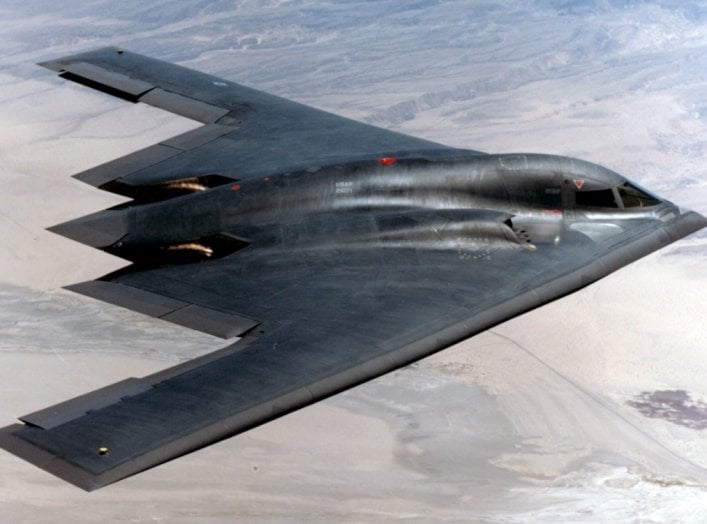
Still, the hard choices here are few. Many were hopeful that budget savings would include cutting our excessive means of delivering nuclear weapons. But while it delays production of the new ballistic-missile submarine and speaks vaguely of a “different” sort of nuclear arsenal, it supports the continuation of the triad. There is still hope on this front, however. The air force plans to build its next bomber initially without nuclear-weapons-delivery capability, adding it later in development. That amounts to dangling bait for budget cutters. Like the F-35B, the nuclear bomber has an unnecessary mission that a more austere budget would cause us to reconsider

So while the changes in this budget may be the first step towards a more restrained military posture, including perhaps a strategy of offshore balancing, they are a small one. A true offshore-balancing strategy would involve a greater shift of resources from the army to the navy. This budget, by contrast, seems unlikely to end the traditional budget split where each service gets roughly one-third of the base.

Unsurprisingly, Secretary Panetta used his press conference yesterday to push Congress to amend the Budget Control Act to avoid sequestration, the across-the-board cuts in the Pentagon’s budget due next January, which would roughly double the cuts outlined here. I have argued that these pleas seem to play into Republican’s hand in the coming budget negotiations. Readers should also know that the Pentagon could avoid the “meat-axe” nature of sequestration (to use Panetta’s language) by budgeting at the level sequestration would accomplish, roughly $492 billion, or about what non-war defense spending was in 2007. That would let the Pentagon choose how to make cuts. The strategic insights guiding these minor cuts could be exploited to make those larger ones.

Support for Whacking Iran: Who Needs Propaganda?

Lurking beneath the recent debate about a military strike on Iran is a question that has received relatively little attention so far: the question of public support. Hawks, thus far, have relied on the notion that a military victory will bring approval, while critics have argued that the Iraq experience has produced an American public unwilling to support further adventurism in the Middle East. Both sides are wrong.

The Hawks are wrong because what Iraq and Afghanistan (and Vietnam long before) have illustrated is the tenuous connection between military outcomes and political success. The critics of intervention are wrong because the most recent polling reveals an American public willing, albeit by a slim majority, to approve military action in order to prevent Iran from developing nuclear weapons.

The most interesting thing about public opinion toward the Iran question, however, is what has been absent from the debate thus far: presidential fearmongering and threat inflation. As the table below reveals, support for military action against Iran today is almost exactly the same as support for the invasion of Iraq right before the war began.

The $64 takeaway from this surprising, even shocking, comparison is just how irrelevant presidential propaganda must have been in forming opinions about the invasion of Iraq. A decade removed from 9/11, public support for a potential military strike on Iran is almost exactly the same it was for the attack on Iraq. And this is despite the Bush administration’s repeated exaggerations about Iraqi WMD, despite the Bush administration making Iraq the focus of a year-long public-relations effort, despite the fact that Americans already loathed Saddam Hussein, despite overwhelming support for the war on terror and despite the fact that fully half of the public believed that Saddam Hussein was personally involved with 9/11.

By contrast, though he has certainly put pressure on Iran through multilateral diplomacy and economic sanctions, Obama has spent no time building public support for military action against Iran and relatively little time talking about Iran at all. According to the Pew News Index, Iran didn’t even crack the top twenty news stories of 2011. And in fact, it is far from clear that Obama himself has any stomach whatsoever for military action against Iran under any circumstances. And yet a majority of Americans support military action to prevent Iran from going nuclear.

Of course, the two situations aren’t perfectly analogous. One might argue that it is “easier” to support a potential air strike on Iran than an invasion of Iraq because it is less risky and less likely to cause casualties. I would argue, however, that on almost every count the case against Iraq was far stronger than the case against Iran is at present, mostly for the reasons just outlined but also because all the polling data from after the Congressional vote authorizing Bush to use force are biased toward support; to many people the war by then was inevitable. Bush’s inability to move the needle even at that point compared to the current support for Iran strongly suggests that there was little he could do to move it.

It turn, it is safe to say that if presidential propaganda wasn’t able to do much in the case of Iraq when the president was going all out, it certainly can’t have done much to shape opinion regarding Iran when Obama has (purposely) done so little.

The implications of this conclusion are twofold. First, presidential propaganda is limited in its impact. As I have argued previously in this blog and at length elsewhere, public predispositions regarding dramatic issues of war and peace are healthy enough to form robust bulwarks against presidential PR efforts, even those hopped up on lies, innuendo and spin control. That should be reassuring for us all, at least under most circumstances.

The second implication, however, is more troubling. It appears that at least in two recent cases, presidential propaganda has not been necessary for building modest coalitions of support for using military force. All a president need do, it seems, is to engage a rogue state over nuclear weapons and let nature take its course. A wise president would note, of course, that such majorities tend to be fragile and not particularly well-informed. But given the political capital that a majority, however tenuous, can give a determined commander-in-chief, we would do well to pay more attention to how public opinion in the post-9/11 world is structured.

Iran

Follow The National Interest

February 12, 2012