
America's Future Navy: Dispersed, Unmanned and Underwater
That is the goal. Now comes the time to build consensus.
While the United States Navy will likely require a larger fleet to counter growing threats from around the world, the service is taking its time to ensure that it can deliver a realistic and executable force structure plan. As such, the Navy’s leadership is working on building consensus with the Pentagon leadership and Congress before releasing its force structure assessment for the future.
“Arguably, this involves a larger and more capable Fleet, resourced to be ready and manned to win,” Adm. Bill Moran, vice chief of naval operations, told a luncheon at the Naval Submarine League annual symposium on Oct. 27. “What exactly that looks like is still being studied—we have learned a lot as part of that process. There will continue to be much discussion and collaboration within Navy, with OSD [Office of the Secretary of Defense] and with the Congress, as we all work together to build and fund the right Navy and joint force for the future. We look forward to sharing some of those results as part of the budget drop later this year.”
The Navy is undertaking a series of reviews, one, the force structure assessment, is currently underway at the Pentagon under the auspices of the service’s leadership. Three other Congressionally mandated studies look further out into the future—one internal to the Navy, another conducted by a federally-funded research center and another by a think-tank—are nearly complete and are currently in the process of being approved before being submitted to lawmakers. All four reviews are likely to call for a larger fleet and will likely be shared with the Congress before the new President submits his or her budget proposal.
"It’s no secret, given the threat, we will likely need a larger fleet, deployed and postured in new and different ways, but that doesn't happen overnight,” a senior Navy official told The National Interest. “Our team is working very hard to build consensus within OSD and on the Hill to make this happen. This is going to be a team effort.”
Generally speaking, the Navy will operate in a much more dispersed manner to maintain its presence around the globe while still maintaining its striking power. “First, our naval forces will operate in a more distributed manner in the future…led by Fleet Forces Command, we are working on a fleet design that will outline a more maneuverable and integrated Navy with distributed firepower enhancing our core capabilities,” Moran said. “At the same time, we are developing networked systems that will improve our manned-unmanned teaming.”
One of the keys to the Navy’s future force structure architecture will be the submarine fleet. “Our elite undersea forces are making critical contributions to our security,” Moran said. “This summer I visited Henry M. Jackson and her crew in Bangor and was inspired by the pride that emanated from these skilled professionals. We need to make sure we continue to provide our sailors with the best tactics and equipment.”
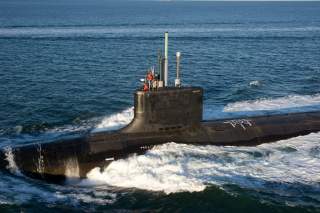
The Navy does not have enough submarines to meet the demand for undersea assets with the 52 boats currently in the fleet, which is more than the stated requirement for 48 attack subs (SSN). However, even if the Navy increases the requirement for the number of submarines, the service is physically incapable of increasing the number of boats in the fleet significantly by the late 2020s. However, the service is trying to mitigate the gap by extending the lives of older Los Angeles-class SSNs so that they can deploy one more time. The Navy also hopes to buy a second Virginia-class SSN in fiscal year 2021 and continue buying two attack submarines per year indefinitely. That is the only way for the Navy to recover from the current submarine deficit.
However, given the insatiable demand for ships and submarines around the globe, the Navy recognizes it will never have enough assets to meet every combatant commander request. Thus, the service is turning toward unmanned technology. “There will be an increased reliance on unmanned systems in the future,” Moran said. “The Navy is fielding and developing several different multi-domain unmanned systems. We are also moving forward in applying accelerated acquisition approaches to unmanned air and undersea platforms to get these capabilities to the fleet as fast as possible where we can start to learn and iterate their roles in enabling the fleet.”
Meanwhile, recapitalizing the all-important sea-based strategic deterrent—which will comprise 70 percent of America’s nuclear arsenal—remains the Navy’s top priority. “The Ohio Replacement Program is the number one priority among several important shipbuilding plans we have coming up,” Moran said. “Sustaining or increasing our planned acquisition of attack submarines and Ohio Replacement submarines is going to be vital to maintain our advantage below the surface and our nation’s vital strategic deterrence.”
Dave Majumdar is the defense editor for The National Interest. You can follow him on Twitter: @davemajumdar.