
Syria after Assad
The president's fall would not end the war. It would merely shift the balance.
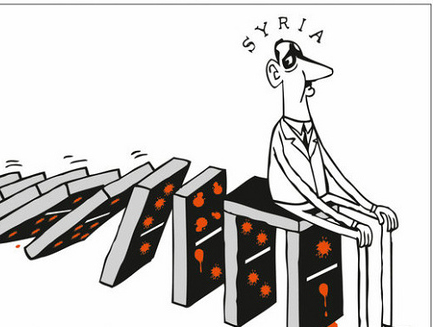 July’s stunning blows to the Assad regime—a bomb attack that killed several key members of his inner circle and a massive rebel offensive in areas across the country—have prompted redoubled efforts to plan for its collapse. Calls for intervention grow louder, and the United States reportedly has abandoned its diplomatic campaign against Assad in favor of preparing for, and hastening, his fall. The word “endgame” is spread liberally over editorial pages and magazine covers. However, as any chess player will tell you, sometimes the endgame is just the beginning—and sometimes the endgame doesn’t end with a win.
Much outside thought about the Syrian conflict has relied upon a liberation narrative: Assad is the oppressor; the people are the oppressed; they are rising to overthrow him. The story is presumed to end with Assad’s fall. There is no doubt that Assad is a loathsome dictator, but the truth is messier.
A unified Syrian people does not exist—the society is shot through with sectarian and ethnic divisions which would make stable governance difficult in any context, and the current conflict is making that all but impossible. Syria’s non-Sunni peoples have long feared that Sunni Islamists will overthrow the secular government and oppress them. This fear has led to crackdowns on Sunnis, the most famous being the destruction of the city of Hama in 1982. Alawites in the intelligence services and upper echelons of the military have overseen a campaign that began with mass arrests and torture but now has shells falling on cities and tanks in the streets. Alawite men of the Shabiha, common criminals in peacetime but militiamen in war, have committed truly unspeakable acts. Young men in cities the regime has conquered are often killed, regardless of their political affiliation. Their bodies are sometimes dismembered and burned. Captured opposition fighters face a similar grim fate.
Despite protestations that they are inclusive and nonsectarian, it is difficult to imagine opposition fighters completely resisting the temptation to seek revenge for these horrendous acts to which they and their kinsmen have been subjected. There already have been reports of abuses by the opposition, including kidnappings, forced confessions and executions. This will feed the fears of Alawites and Christians. So will reports of Islamist fighters operating in parallel to the Free Army; some reportedly are better armed and better funded than the non-Islamist forces. We should not discount the danger of another situation such as the one in Mali’s breakaway Azawad region, where a similar imbalance between local rebels and internationally funded extremists has led to the formation of a terrorist haven.
The Assad regime has stoked sectarian fears eagerly to challenge the liberation narrative, reportedly paying Alawite government employees to put up anti-Alawite and anti-Christian graffiti and depicting the entire rebellion as Islamist: rebels have complained that the state trumpets images of bearded fighters as proof of fundamentalism, even though for some fighters the beard is proof of the inconvenience of shaving in the field. One young guerilla joked to the L.A. Times, “We're going to start fighting with a bottle of whiskey in our hand, just so the world sees we're not Al Qaeda.” Extremist or not, rebels entering Alawite and Christian communities will be seen as harbingers of tyranny and massacre, not freedom.
Because of these fears, the Assad regime is unlikely to vanish the moment Damascus falls. Instead, it will withdraw its forces and as many of its heavy weapons as possible to the Christian and Alawite homelands west of Hama and Homs. These homelands, centered on the cities of Tartous in the south and Latakia in the north, are a natural fortress separated from the rest of Syria by the rough terrain of the Jabal an Nusayriyah range, which forms a barrier three thousand to four thousand feet high backed by a labyrinth of ridges and valleys. Any FSA attempt to unify all of Syria would thus face the unenviable task of conquering this harsh terrain and then maintaining supply lines through it. Even if they were successful, their reward would be continuing urban combat and holding operations against Assad’s last “dead enders,” all amid an unfriendly population that sees them as conquerors, not liberators. This would be a difficult operation for any military, but the Free Army, with its imperfect organization, light armament and current focus on guerrilla fighting, would be unlikely to pull it off in the face of resistance.
Even if the Free Army conquers the Syrian northwest, it then would have to rebuild the state’s institutions in a credible, nonsectarian manner. Reintegration of blood-smutched Alawi officers into the police and army would be a tough sell to the Sunnis. And the Alawis and Christians would be just as skeptical of any government effort to punish the worst offenders. Other solutions, like the amnesties and truth commissions used in places like Northern Ireland and South Africa, seem far too abstract to bind the gash that has opened within Syrian society.
This gives a comic air to the renewed calls for Western involvement, which note the inescapable challenges facing Syria regardless of who is in power, yet quickly wave them away. Witness the Economist leader “Towards the Endgame”:
Western governments should try to give the military effort against Mr. Assad a further push. The swiftest way of doing that would be to give aid—such as money and communications gear—to the main rebel force, the Free Syrian Army. It is already getting arms and cash from Qatar and Saudi Arabia with Turkish co-operation, but it needs more help. . . . The FSA is no band of angels. Some of its weapons will doubtless fall into the wrong hands, possibly including groups of jihadists. Flooding Syria with arms will make the country harder to govern once Mr. Assad has gone. But backing the FSA is probably the quickest way to prize Mr. Assad from power.
This argument is rather sensible within the liberation narrative, for in that view Assad’s removal signals the end of major hostilities. Arming, equipping and funding the Free Army is indeed the quickest way short of direct intervention to remove Assad from Damascus, but this is not a Napoleonic-era conflict in which control of the capital is decisive. Damascus will fall, and perhaps Assad the man will fall with it—captured, killed or overthrown. But Assad the regime will pull back into the mountains. Liberation will not take place. The war will not be over. The balance will merely have shifted.
John Allen Gay is program assistant for the Regional Security Program and the Program on American National Security in the Twenty-First Century at the Center for the National Interest.
Image: FreedomHouse