
The Triumph and Tragedy of Greater Israel
How the achievement of a de facto one-state solution has imperiled Israel's very existence.
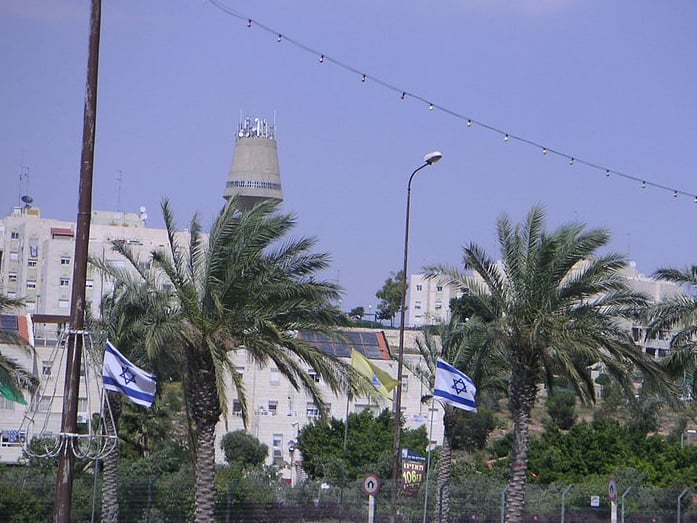 Ma'ale Adumim, an Israeli settlement in the West Bank.The Middle East peace process is dead. More precisely, the two-state solution is dead; the peace process may well go on indefinitely if this Israeli government has its way.
The two-state solution did not die a natural death. It was strangulated as Jewish settlements in the West Bank were expanded and deepened by successive Israeli governments in order to prevent the emergence of a viable Palestinian state. The settlement project has achieved its intended irreversibility, not only because of its breadth and depth but also because of the political clout of the settlers and their supporters within Israel who have both ideological and economic stakes in the settlements’ permanence.
The question can no longer be whether the current impasse may lead to a one-state outcome; it has already done so. There is also no longer any question whether this government's policies will lead to what can legitimately be called apartheid, as former prime minister Ehud Olmert and other Israeli leaders predicted they would. Palestinians live in a one-state reality, deprived of all rights, and enclosed in enclaves surrounded by military checkpoints, separation walls, roadblocks, barbed-wire barriers and a network of “for-Jews-only” highways.
Until now, Israel’s colonial project has been successfully disguised by Prime Minister Benjamin Netanyahu’s pretense that he is pursuing a resumption of talks for a two-state solution with President Mahmoud Abbas. It has also been strengthened by the pretense of President Obama and EU leaders that they believe a resumed peace process can still produce a Palestinian state. But these pretenses cannot be sustained for long, if only because of the inability of settlers to restrain triumphalist pronouncements of their achievement of Greater Israel and their defeat of the Palestinians’ hopes for statehood—as Dani Dayan did recently in the op-ed pages of the New York Times and Haaretz, in which he proclaimed that because of the settlements’ irreversibility there will be only one sovereignty west of the Jordan River.
But paradoxically, the triumph of the settlement project contains the seeds of its own reversal—or of the demise of the Zionist project.
First, some history. Israeli decision-making elites long ago made a cold cost-benefit calculation that the benefits of establishing permanent Israeli control over the entire West Bank exceed the cost. Immediately following the 1967 Six Day War, Israel’s government announced it would withdraw from occupied territories in Egypt and Syria in return for those countries' recognition of Israel but made no such offer to the Palestinians. When asked in 1968 what would be the future of the Occupied Territories, Moshe Dayan—the legendary IDF chief of staff and, at the time, Israel's minister of defense—replied with characteristic bluntness: their future, he said, “is being implemented in actual fact. What exists today must remain.” In 1977, replying to that same question, he said, “The question is not what is the solution, but how to live without a solution.”
As for what to do with the millions of Palestinians who live within Israel’s enlarged borders, many Israelis believe that the long-unacknowledged silent ethnic cleansing that has been going on for years in what was designated by the Oslo agreement as area C, comprising over 60 percent of the West Bank, can continue for the time being. And when it no longer can, then Israel would unilaterally draw borders around areas A and B and call the imprisoned enclaves within that area a Palestinian state.
Advocates of Greater Israel also believe that by granting (or pretending to grant) citizenship to the small number of Palestinians who have managed to resist expulsion from area C, which would be formally annexed, the apartheid issue will have been neutralized—at least sufficiently so to placate American Jews and the U.S. administration. That was stated explicitly by Naftali Bennett, a confidant of Netanyahu and a settler leader who reported that his proposal for Israel’s annexation of area C was well received by Israel's political, military and security establishments.
There is one price, however, that the vast majority of Israelis, including many if not most settlers, will not pay for a Greater Israel: the loss of the state’s Jewish identity. Israeli polls have confirmed this repeatedly. It is an issue that Israelis believe can be finessed, either by continuing to hold out the promise of a two-state solution in an undefined future or by carving up the West Bank in a manner that excludes the heavy concentrations of Palestinian population from Greater Israel, as advocated by Bennett and others. But if those two options were precluded and the choice were to either grant citizenship to the Palestinian residents of a Greater Israel or a two-state arrangement with limited and equal territorial exchanges, Israel’s cost-benefit calculations would have to change.
And it would come down to that choice if the disguise of the existing Greater Israel were stripped away. The issue for the United States would then no longer be where the borders of a Palestinian state are to be drawn—a matter Washington has for all practical purposes left to the Israelis to decide—but whether it is prepared to defend what increasingly would be seen by everyone as an apartheid regime.
It is unlikely that even those Western democracies accustomed to pandering to their Israeli lobbies would be prepared to shield Israel from condemnations and sanctions when its apartheid can no longer be disguised. One must assume that no American president would again declare at a UN General Assembly that Palestinian victims of such a system should seek relief not from the UN or international courts but from their occupiers.
The key to changing the deadlocked status quo is therefore exposing the Greater Israel that has been created by the settlement project in the West Bank and the de facto apartheid regime under which Palestinians now live. But the United States and the European Union will not be the whistle-blowers, most certainly not as long as Palestinians themselves continue to collaborate with Israel’s pretense that a one-state reality does not yet exist, a collaboration implicit in their adherence to the Oslo framework and to the myth that the Palestinian Authority and the strengthening of its institutions can still pave the way for Palestinian statehood.
Nothing would expose more convincingly the Israeli disguise of the one-state reality now in place than a Palestinian decision to shut down the Palestinian Authority and transform their national struggle for independence and statehood into a struggle for citizenship and equal rights within the Greater Israel to which they have been consigned. Only by declaring that Palestinians will no longer be complicit with their occupiers in their own disenfranchisement will Israelis be confronted with the need to choose between a two-state arrangement and a single state that sooner or later will lose its Jewish identity.
In recent talks with Palestinian leaders, some of them told me they fear that Israel would take advantage of such a move to annex area C and consign Palestinians to enclaves in areas A and B, as proposed by Bennett. But Israel's government has already done so. Only those blind to the facts on the ground created by the settlements can believe there still exists a possibility for a two-state outcome that might be put at risk. And the sooner Palestinians expose their new reality the better. For an Israeli land grab in area C that would follow the launching of a Palestinian anti-apartheid struggle is far more likely to be seen by the international community as confirming Israel’s apartheid than a land grab that precedes it—i.e. when the issue is still presented by Israel as the setting of the border between two states.
Friends of Israel should fervently hope that such a Palestinian strategy will succeed in changing the cost-benefit calculations of Israel’s government, for the success of the settlements holds the seeds of Israel's demise. Palestinians have lived under Israeli occupation for nearly half a century and will endure, if they must, another half century. They have few alternatives.
However, it is highly doubtful that Israel can survive another half century of its subjugation of the Palestinians. The region has been radically transformed by the emergence of Islamic regimes that, unlike their predecessors, will not suppress Arab furies provoked by Israel's permanent disenfranchisement of the Palestinians. America's ability to impose its own political order on the region is in decline. Even Arab royals in Saudi Arabia, Jordan and the Emirates will be pressed to prove their legitimacy by joining efforts to deepen the ring of Arab hostility that surrounds and threatens the Jewish state. America's fading influence and Israel's growing vulnerability in this emerging regional order have already been exposed by Egyptian president Mohamed Morsi's decision, in defiance of American objections, to attend a conference of nonaligned nations hosted by Iran. The heightened sense of isolation and insecurity that Israelis will experience as Arab countries join the nuclear club, which in time they surely will, is bound to lead to an exodus of Israel's best and brightest, and in time it could spell the end of the Zionist dream. As reported in Israel’s press, the search in certain sectors of Israeli society for foreign passports and second homes abroad has already begun.